
"Mata'AITU"(voyeur) Exhibition...
The Colonial Gaze:
"TOLIO"
A 10-year old Samoan boy (ancestor) taken by the Carl & Fritz Marquardt brothers between 1895 and 1911, to GERMANY, without his parents, and put on display in Völkerschau (human zoos), a 'living diorama' made popular by Carl Hagenbeck from Hamburg.
Today, TOLIO’s AITU, reactivates this STATIC photograph that captured him, transcending power dynamics of old, by walking out of his enclosure.
Generative Ai...Regenerating (Ai)TU™ by Lindah Lepou™.
Images courtesy of MARKK Museum, Hamburg, Germany. #zoolog
"Mata'AITU"(voyeur) Context…
"Mata'AITU" forces the observer into the mirror of their own consumption, shifting power back to indigenous sovereignty. Modern digital ecosystems turn users into self-consuming producers, trading privacy for platform visibility (Lepou™, 2026).
A direct lineage connects colonial human zoos and early ethnographic cinema to today's algorithmic surveillance, culminating in this 2026 exhibition launch (Thode-Arora, 2020; Flaherty, 1926; Lepou™, 2026).
Using Generative AI to animate static archival ancestral photography transforms a mechanical (voyeuristic) tool of historical ‘capture’ into a medium of spiritual resurrection, waking the (Ai)TU™ across a separation of time and freeing TOLIO from this ‘enclosure’.
Generative AI...Regenerating (Ai)TU™ by Lindah Lepou™, is a decolonization works that reclaims ones own indigenous GAFA identity and (Ai)TU™ communication to defy colonial framing, rendering death irrelevant and asserting eternal presence today (Lepou™, 2026).
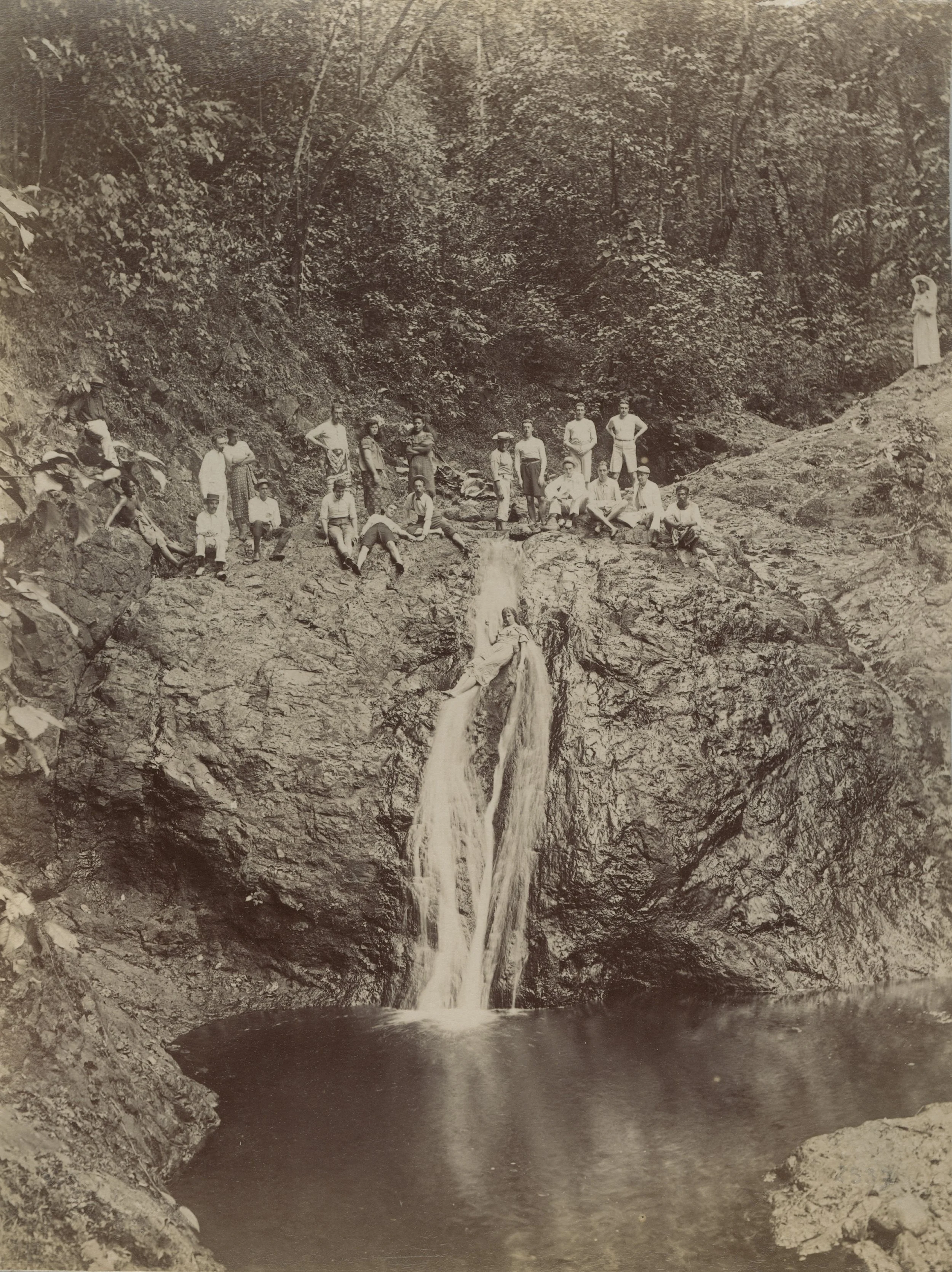
Papase’ea ‘Sliding Rocks’, Upolu, Samoa (c.1900).
Wooden REPLICA, Garten, Hamburg, Germany (c.1910).
Glossary
“Mata’AITU” pronounced: MAH-TAH-AHH-EE-TOO
‘Mata” : Eye/s / Face / Gaze
“Aitu” : Spirit / Ancestor / Ghost
Krafft-Ebing, Richard von (1886)
Establishes the foundational late-19th-century medical-forensic framework for classifying sexual anomalies, fetishistic patterns, and behavioral deviations.
Binet, Alfred (1887)
Formally coins and analyzes the psychological terminology of sexual objectification and fetishism, linking it to early behavioral impulses.
Conceptualizes scopophilia (pleasure in looking) and developmental components of the human gaze rooted in psychological drives.
Examines the romanticized staging of indigenous life and the genesis of the cinematic ethnographic gaze.
Sartre, Jean-Paul (1943)
Establishes the definitive philosophical blueprint of "The Gaze" and keyhole voyeurism that shatters autonomous power.
Traces the foundational psychiatric codification of voyeurism and scopophilia originating with Krafft-Ebing and Binet in the 1880s.
Details the mechanics, history, and institutional framework of Samoan ethnic shows (Völkerschau) in Europe from 1895 to 1911.